
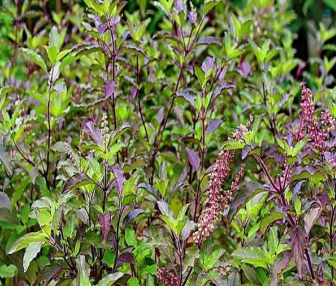
Tulsi (Ocimum sanctum Linn.)
Family: Lamiaceae
Tulsi is an annual, highly branched aromatic plant growing 30–60 cm in height. The stem and branches are usually purplish and sub-quadrangular. Leaves are elliptic-oblong, pubescent on both sides and minutely gland-dotted. Flowers are borne in racemes. It is widely valued for its medicinal, spiritual and aromatic importance.
Common Names:
Holy Basil, Krishna Tulsi, Manjari, Brinda
English – Holy Basil, Indian Basil, Sacred Basil
Hindi – Tulsi
Sanskrit – Tulasi
Kannada – Sri Tulasi
Telugu – Tulasi
Distribution:
Found throughout India and cultivated widely across the country.
Part Used:
Leaves and whole plant.
Soil and Climate:
Tulsi thrives in a wide range of soils from rich loam to poor laterite, including saline and moderately acidic soils. Well-drained soil supports better vegetative growth, while waterlogging may cause root rot and stunted growth. It grows well under high rainfall and humid conditions. Long days and high temperatures favor plant growth and oil production. Tropical and subtropical climates up to 900 m altitude are suitable.
Land Preparation:
The land should be brought to fine tilth and divided into convenient plots for irrigation. About 15 tonnes of farmyard manure per hectare should be applied and mixed well during land preparation.
Nursery Raising and Planting:
Nursery raising is done in the third week of February and transplanting begins by mid-April. Propagation is through seeds. Raised seed beds should be well prepared and manured. Approximately 200–300 g of seeds are sufficient for planting one hectare. Seeds are sown 2 cm deep and germinate within 8–12 days. Seedlings reach transplanting stage in about 6 weeks (4–5 leaf stage). Transplanting is done at spacing of 40 × 40 cm or 40 × 50 cm for better herbage and oil yield.
Weeding and Hoeing:
First weeding is carried out one month after planting and the second four weeks later. One hoeing after two months is generally sufficient.
Manures and Fertilizers:
The crop is preferably grown organically. Farmyard manure, vermicompost and green manure may be applied as required. Bio-pesticides prepared from neem, cow urine and other botanical extracts may be used for disease management.
Irrigation:
Irrigation depends on soil moisture. During summer, three irrigations per month are required, while in the rainy season irrigation is generally not necessary. About 12–15 irrigations annually are sufficient.
Harvesting and Post-Harvest:
The crop is harvested at full bloom stage. First harvest is obtained 90–95 days after planting and subsequent harvests can be taken at 65–75 day intervals. Harvesting should be done on bright sunny days for better oil yield and quality. Avoid harvesting immediately after rainfall.
Yield:
Approximately 5 tonnes of fresh herbage per hectare can be obtained twice or thrice a year.
Economics:
Expenditure per hectare – Approximately Rs. 1,000/-
Return per hectare – Rs. 5,000 to 6,000 (within 2½ months)
Net income – Rs. 4,000 to 5,000 (Year 2001; subject to market variation).
Medicinal Uses:
Tulsi is regarded as a highly valuable medicinal herb. It is traditionally used for managing fever, respiratory disorders, asthma, common cold and sore throat. Leaves are applied for skin problems such as acne and premature ageing. It is also used for treating insect bites, headaches, kidney stones and heart-related ailments. Tulsi supports immunity and overall wellness, making it an important herb in traditional medicine.

Reviews
There are no reviews yet.