
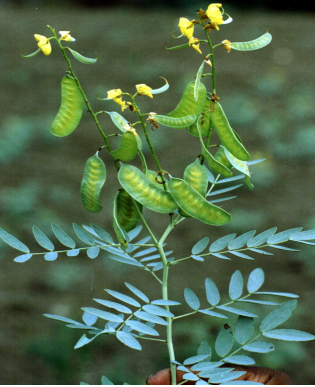
Cassia angustifolia Vahl
Family: Caesalpiniaceae
A variable, branching, erect shrub growing up to 1.8 m height. Leaves pinnate and pubescent with 3–9 pairs of pale to bluish-green lanceolate or elliptic leaflets (1.5–5.0 cm long). Flowers brilliant yellow in erect terminal racemes. Pods flat, thin, oblong, light green when young turning dark brown or black at maturity. Seeds dark brown, obovate-oblong (5–7 per pod).
Two botanical sources are recognized under Senna:
1. Cassia angustifolia Vahl – Tinnevelly Senna
2. Cassia acutifolia Delile – Alexandrian Senna
Vernacular Names:
Sanskrit: Pitapushpi, Swarnamukhi, Swarnapatrika
Hindi: Sonamukhi, Sonpat
English: Senna
Kannada: Swarnapatri, Sonamukhi
Tamil: Nattunelavarai, Nelavagai
Telugu: Neelaponna, Neelatangeedu
Distribution:
Distributed in Somalia, Egypt, South Arabia, Sind, India and Sri Lanka. In India, cultivated mainly in Gujarat, Tamil Nadu, Karnataka and Maharashtra. Major commercial cultivation in Tamil Nadu (Madurai, Salem, Ramanathapuram and Tiruchirappalli districts).
Threat Status:
Under cultivation.
Agro-Climatic Requirements:
Requires dry, warm climate with bright sunshine and light showers. Temperature range 10–42°C. Highly drought resistant and suitable for arid regions. Thrives in well-drained soils including sandy loam, gravelly soils and clayey soils. Soil pH 7.0–8.5.
Varieties:
A.L.F.T-2 (Gujarat Agricultural University)
Sona (CIMAP, Lucknow)
Cultivation:
Propagated by seeds.
Seed Propagation:
Spring sowing (March–April) gives better seed quality. Seed rate: 10–27 kg/ha (rainfed) and 7–15 kg/ha (irrigated). Seeds soaked in water for 10–12 hours before sowing. Soaking in liquid cow dung for 6 days enhances germination. Sown broadcast or in rows 30–40 cm apart at 1–2 cm depth. Nursery raising in December and transplanting in February at 15 cm height is also practiced.
Intercultural Operations:
First weeding at 5–10 cm plant height, second at 75–80 days, third at 110 days. Thinning done at 30 days to maintain 30 cm spacing. Rainfed crop; 2–3 irrigations in North India increase yield. Annual rainfall of 25–40 cm sufficient.
Manures and Fertilizers:
Since roots do not fix nitrogen, fertilization is beneficial. Apply 4–10 cartloads FYM/ha. Recommended dose: 50–100 kg N, 20–50 kg P₂O₅ and 20 kg K₂O per hectare during crop duration (135–150 days).
Plant Protection:
Die-back controlled by seed treatment with Captan or Thiram (25 g/kg seed) and field drenching with Bavistin (1%), Brassicol (0.2%) or Rhizoctol (0.1–0.5%). Leaf spot and leaf blight controlled by spraying Dithane M-45 (0.15%) at 15-day intervals. Leaf-eating caterpillars controlled by BHC (5%) dusting.
Harvesting and Yield:
Harvest begins 50 days after sowing and repeated at 70 and 90 days. Younger leaves and 3–5 day old pods contain higher sennoside content.
Yield:
Dry land – Leaves: 330–1500 kg/ha; Pods: 82–500 kg/ha
Irrigated – Leaves: 825–1540 kg/ha; Pods: 165–700 kg/ha
Semi-irrigated – Leaves: 2464 kg/ha; Pods: 184 kg/ha
Cost of Cultivation:
Approximately Rs. 25,000/- per hectare.
Inputs (Per Hectare):
Seeds: 5 kg
FYM: 10 tonnes
Fertilizers: N – 80 kg, P₂O₅ – 40 kg, K₂O – 40 kg
Parts Used:
Leaves and pods.
Medicinal Uses:
A strong purgative, though may cause griping and nausea but does not produce after-constipation. Used in fever, spleen enlargement, anemia, typhoid, cholera, jaundice, gout, rheumatism, tumors and bronchitis. Externally used for certain skin diseases. Leaves combined with henna used as hair dye. Contraindicated in chronic constipation, colitis, piles and pregnancy.

Reviews
There are no reviews yet.