
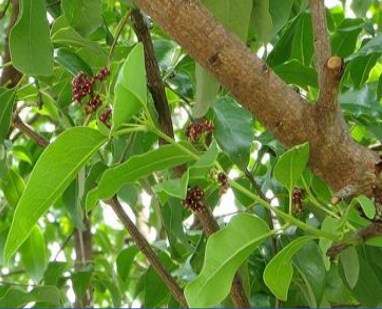
Chandan
Santalum album Linn.
Family: Santalaceae
Chandan is a small evergreen tree and a partial root parasite, attaining a height of 12–13 m and girth of 1–2.4 m, with slender drooping as well as erect branches. The tree starts flowering at an early age of 2–3 years. Fruit is a drupe, purplish when fully matured and single seeded.
Common Names:
Sandalwood, Safed Chandan, Sandal, Chandana
Sanskrit: Chandan, Malayaja, Gosheersha, Tilaparnaka, Shreekhanda, Chandradyuti
Hindi: Safed Chandan, Chandan, Sandal
English: White Indian Sandalwood, Sandalwood, Sandal Tree
Tamil: Chandanam, Sandanam
Telugu: Tella Chandanam
Kannada: Shrigandha, Chandan
Distribution:
Distributed in dry scrub forests of Salem, Mysore, Coorg, Coimbatore and Nilgiris up to 900 m altitude. It is also found in Andhra Pradesh, Bihar, Gujarat, Karnataka, Madhya Pradesh, Maharashtra and Tamil Nadu.
Part Used:
Heartwood.
Cultivation:
Soil and Climate:
It grows well in red sandy loam soil and requires a humid and hot climate.
Nursery Raising and Planting:
Two types of seed beds, sunken and raised, are used for raising seedlings. Beds are prepared with sand and red earth in 3:1 ratio and mixed thoroughly with nematicides (Ekalux or Theimet @ 500 g per 10 m × 1 m bed). About 2.5 kg seeds are spread uniformly, covered with straw and straw is removed when leaves appear. Seed beds are sprayed with 0.25% Dithane Z-78 once in 15 days to prevent fungal attack and 0.02% Ekalux once a month to prevent nematode attack.
At 4–6 leaf stage, seedlings are transplanted into poly bags along with a seed of Tur dal (Cajanus cajan), the primary host plant. Roots should not be allowed to dry. Shade is provided for one week after transplantation. Watering is done daily, avoiding excess moisture. Host plants are pruned regularly to prevent overgrowth. Poly bags should contain soil mixture in 2:1:1 ratio (Sand: Red earth: FYM). Poly bags of 30 × 14 cm size are ideal.
Plantable seedlings of about 30 cm height can be raised in 6–8 months. A well-branched seedling with brown stem is ideal for field planting.
Thinning and Weeding:
Regular weeding is required.
Manures, Fertilisers and Pesticides:
The crop should preferably be grown without chemical fertilizers and pesticides. Organic manures such as Farm Yard Manure, Vermi-compost and Green manure may be used. Bio-pesticides prepared from Neem (kernel, seeds and leaves), Chitrakmool, Dhatura and Cow’s urine may be used for disease prevention.
Irrigation:
It is generally grown as a rainfed crop. Young plants require watering during summer at 15–20 day intervals until fully established.
Harvesting / Post-Harvesting Operation:
Trees are harvested at 30–60 years of age. Softwood is first removed; heartwood is chipped and powdered. The powder is soaked in water for 48 hours and distilled for oil extraction. The oil is rectified by re-distillation and filtration.
Yield:
Sandal is a slow growing tree, increasing about 5 cm girth per year under favorable conditions. Heartwood formation begins around 10 years of age.
| Age (Years) | Girth at Breast Height (cm) | Heartwood Yield (kg/tree) |
|---|---|---|
| 10 | 10 | 1 |
| 20 | 22 | 4 |
| 30 | 33 | 10 |
| 40 | 44 | 20 |
| 50 | 55 | 30 |
Economics (Year – 2001):
Retail rate of heartwood at Government emporium: Rs. 350/- per kg.
Note: Market for medicinal plants is volatile and economics may vary.

Reviews
There are no reviews yet.