
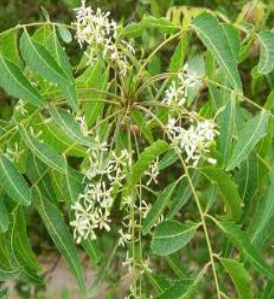
Azadirachta indica A. Juss.
Family: Meliaceae
Neem is a tall evergreen tree with small bright green leaves, growing up to 100 feet in height. The trunk may attain a diameter of 2.5–3 m. The bark is rough, pale to greyish-black. The tree bears small white, star-shaped fragrant flowers. Fruiting generally begins at 3–5 years of age, and the fruits are edible when ripe.
Common Names:
Sanskrit: Nimba, Arishta, Ravipriya
Kannada: Bevina-mara, Bevu, Kahibevu, Nimba, Ollebevu
English: Neem, Margosa
Telugu: Vepa
Tamil: Vembu
Malayalam: Veppu
Distribution:
Probably native to India and widely distributed across the Indian subcontinent. Common throughout India and frequently cultivated. In Karnataka, found abundantly in regions such as Agumbe, Sandur and Devarayanadurga.
Agro-Climatic Requirements:
Adaptable to a wide range of soils including sandy, clayey and black cotton soils. Thrives on well-drained soils with good sub-soil moisture. Tolerates temperatures from 0°C to over 40°C and altitudes up to 1500 m. Can survive in areas with annual rainfall as low as 130 mm. Soil pH tolerance: 5–10. Possesses strong drought resistance.
Varieties:
No named varieties reported.
Cultivation:
Propagated through seeds.
Seed Propagation:
Seeds have short viability (about two weeks). For better germination, seeds are soaked in water for 24 hours and the endocarp removed or seed coat slightly cut. De-pulped seeds are sown in nursery beds of fine sand in rows 15–20 cm apart, seeds spaced 2.5–5 cm apart at 1–2 cm depth. Light watering is required. Germination occurs in 1–2 weeks with 70–90% success.
Transplanting and Aftercare:
Seedlings 7–10 cm tall with 15 cm taproot are transplanted into polybags. Field planting after 1–2 years at 4.5–5.5 m spacing. Light watering during initial 5–6 years in summer supports establishment.
Irrigation and Interculture:
Minimal irrigation required during monsoon. Light irrigation during summer benefits young plants. Mature trees require no irrigation. Annual pruning during November–December encourages better framework and growth.
Inputs (Per Hectare):
Number of seedlings: 280
Farmyard Manure: 25 tonnes
Plant Protection:
Major Insects: Thrips, defoliator, shoot borer, termites.
Major Diseases: No serious diseases reported.
Control Measures:
• Thrips: Spray dimethoate @ 0.1–0.2 ml per litre.
• Shoot borer: Spray 0.02% monocrotophos.
• Defoliator: Spray 0.1–0.2% folithion.
• Termites: Drench soil with heptachlor or chlordane 50EC before and after planting if required.
Harvest and Yield:
Flowering occurs during March–April. Fruits ripen June–August. Harvest when fruits turn bright yellow. About 8,000–10,000 kg fresh berries per hectare annually. Fresh fruits yield 60% dry fruits, containing about 10% kernel with approximately 45% fixed oil.
Cost of Cultivation:
Approximately Rs. 37,500/- per hectare.
Parts Used:
All parts – leaves, bark, root, flowers, fruits and seeds.
Medicinal Uses:
Neem parts are used in juice and decoction forms for treating fever, piles, wounds, oedema, arthritis, skin disorders, diabetes, jaundice, dental disorders and various infections. Decoctions combined with other medicinal plants are traditionally used for skin diseases and diabetes. Neem leaf preparations are widely used for wound cleansing and healing. Internal use helps manage worm infestation and balance bodily disorders. It is also used for fumigation and as a digestive aid.

Reviews
There are no reviews yet.