
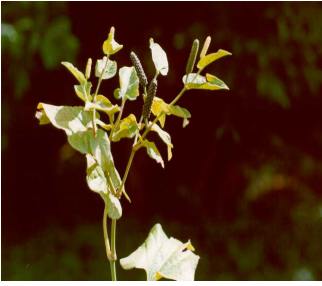
Piper longum Linn.
Family: Piperaceae
A slender aromatic climber with perennial woody roots. Stems creeping and jointed; young shoots downy. Leaves 5–9 cm long and 3–5 cm wide, ovate, cordate with broad rounded lobes at base, sub-acute, entire and glabrous. Spikes cylindrical, pedunculate, axillary or extra-axillary; green initially, turning yellow later. Flowers minute and unisexual; male flowers larger and slender, female spikes 1.3–2.5 cm long and 4–5 mm diameter. Fruits small drupes, dark red when ripe, ovoid, yellowish-orange and embedded in fleshy spike.
Distribution:
Distributed in India, Sri Lanka, Nepal, Malaysia, Indonesia and Philippines. In India, found in hotter regions from Central Himalayas to Assam, Khasi and Mikir hills, lower hills of Bengal and evergreen forests of Western Ghats from Konkan to Travancore. Also recorded in Car Nicobar Islands.
Vernacular Names:
Sanskrit: Pipali
Hindi: Pipal
English: Long Pepper
Kannada: Hippali
Telugu: Pippuloo
Tamil: Tippili, Pippili
Malayalam: Tippali, Pippali, Magadi
Varieties:
Gol Tippali (West Bengal), Pipal Nan Sori (Maharashtra), Asli and Suvali (Assam), Vishwam (Kerala Agricultural University and CIMAP).
Agro-Climatic Requirements:
Thrives under tropical forest conditions with cool shade, high humidity and good soil moisture with proper drainage. Best suited to clayey loam soil rich in organic matter. Cultivated in limestone soils at 450–600 m altitude below Cherrapunji region where rainfall and relative humidity are high.
Cultivation:
Grown as intercrop with coconut, arecanut, coffee, cardamom and orange. Propagated by layering of mature branches or by suckers planted at onset of rainy season. Plants are well manured with cow dung cake. Weekly irrigation is required in fully grown plantations; when grown as subsidiary crop, irrigation of main crop is sufficient.
Intercultural Operations:
Weeding and digging once during south-west monsoon and again during north-east monsoon to conserve moisture and prevent weeds. Contour bunding and terracing are adopted to prevent soil erosion.
Manure and Fertilizer:
Apply 20 tonnes FYM or compost per hectare. Fertilizer dose: 50 kg Nitrogen in two split doses, 20 kg P2O5 and 70 kg K2O per hectare at transplantation.
Plant Protection:
Major diseases: Wilt and Pollu disease. Wilt causes root decay, yellowing and drying of plant. Pollu causes hollowness and destruction of fruits. Spray Bordeaux mixture (0.1%) in May and 2–3 times during rainy season.
Major pest: Helopeltis theivora causing leaf damage. Spray neem decoction (0.25%) for control.
Harvesting and Yield:
Spikes appear after 6 months of planting and take about 2 months to mature. Harvest in January while spikes are green and unripe for maximum pungency. Dry in sun until grey in color.
Yield increases from 560 kg/ha in first year to 1680 kg/ha in third year. After third year, vines become less productive and should be replaced. Plants without spikes are harvested after 18 months for roots and stem, yielding about 500 kg roots per hectare.
Cost of Cultivation:
Approximately Rs. 62,500/- per hectare.
Inputs:
| Sl. No | Materials | Per Acre | Per Hectare |
|---|---|---|---|
| 1 | No. of Rooted Cuttings | 10,890 | 27,660 |
| 2 | Farm Yard Manure (t) | 8 | 20 |
| 3 | Fertilizer (kg) | Mostly grown as undercrop on residual fertility; exact fertilizer requirement yet to be standardized. | |
Parts Used:
Fruit, root and thicker stem portions.
Medicinal Uses:
Fruits and roots are used in respiratory diseases such as cough, bronchitis and asthma. Applied locally as counter-irritant and analgesic for muscular pain and inflammation. Used as snuff in coma and drowsiness; internally as carminative, sedative, general tonic and haematinic. Acts as cholagogue, emmenagogue, abortifacient and anthelmintic. Used in dysentery and leprosy. Fruits enhance intellect and memory. Roots are aphrodisiac, febrifuge and useful in rheumatism and arthritis; also considered antidote for scorpion bite.
The method known as Vardamana Pippali (gradual increasing dosage) is beneficial in paraplegia, elephantiasis, chronic cough, tumors and gastric disorders.
Important compound preparations include Bhaskara Lavana, Panchkola Churna and Asta Churna for dyspepsia and gastritis, and Pippali Arista for asthma, cough and piles.

Reviews
There are no reviews yet.