
Liquorice (Mulethi)
Glycyrrhiza glabra L.
Family: Fabaceae
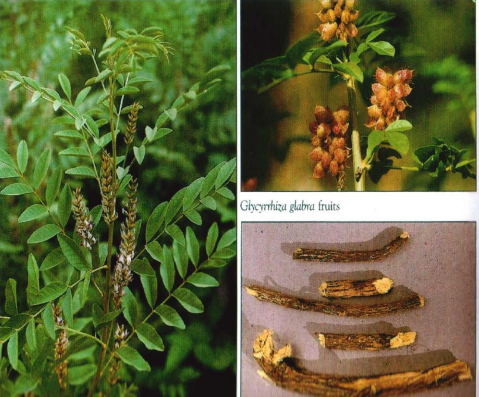
Mulethi is a perennial undershrub reaching up to 1.2 m height under favorable conditions. The root crown produces long woody stems bearing compound pinnate leaves. Flowers are pale blue and appear from the second or third year onward. Fruits are 2–2.5 cm long pods containing 2–5 seeds.
Common Names:
Liquorice, Madhukah, Yestimadhu
Sanskrit: Yastimadhu
Hindi: Mulethi, Jethimadhu
Kannada: Atimadhura, Jeshtamadhu
Tamil & Telugu: Atimadhuram, Irattimadhuram
Distribution:
Widely distributed from 5°W to 100°E longitude and 20°–50°N latitude. Abundant in Western China, Asia Minor, Persia, Asian Republics of former USSR and Afghanistan. Cultivated in Punjab and sub-Himalayan tracts of India.
Part Used:
Root.
Cultivation:
Soil and Climate:
A hardy plant growing on rich forest soils, slightly acidic to alkaline (pH 5.5–8.2). Thrives in Mediterranean type climates. In India, sandy loam fertile soils with pH 6–8.2 favor better root development. Requires 50–100 cm annual rainfall; irrigation improves yield. Avoid waterlogging.
Nursery Raising and Planting:
A long duration crop. Field should be well prepared and leveled. Underground stem/root cuttings (15–25 cm long with 2–3 eye buds) are planted 6–8 cm deep at spacing of 90 × 45 cm or 60 × 45 cm. About 250–300 kg wet stem cuttings are required per hectare. Sprouting begins within 15–20 days. Light and frequent irrigation is necessary during establishment. Planting is done during February–March or July–August.
Thinning and Weeding:
Three to four hoeings and weedings in first year; two in subsequent years to maintain weed-free conditions.
Manures, Fertilisers and Pesticides:
Preferably grown without chemical fertilizers and pesticides. Organic manures such as FYM, Vermi-compost and Green manure may be applied. Bio-pesticides prepared from Neem, Chitrakmool, Dhatura and Cow’s urine may be used if required.
Irrigation:
Irrigation at 30–45 day intervals during summer. No irrigation during winter as plants shed leaves in November. Total 7–10 irrigations required annually. Avoid water stagnation to prevent root rot.
Harvesting / Post-Harvest:
Higher yields are obtained from 2½–3 year old crop. Roots are harvested manually or by disc harrow in winter (November–December) for higher glycyrrhizic acid content. Roots are sun dried for 2–3 days and then shade dried for 10–12 days until moisture content falls below 10%. Roots are graded based on thickness and stored in polythene-lined bags.
Yield:
70–80 quintals per hectare at Hissar (Haryana). At Anand, 20–25 quintals per hectare from 10–20 months crop.
Economics (Year – 2001):
Return: Rs. 3,50,000/- to 4,00,000/- per hectare.
Note: Market for medicinal plants is volatile and economics may vary.
Health Benefits of Mulethi:
1. Boosts Immunity: Supports production of lymphocytes and macrophages. Traditionally consumed as tea.
2. Controls Cholesterol: Antioxidants help regulate lipid profile and improve vascular health.
3. Cough and Cold Relief: Acts as expectorant and bronchodilator. Useful in asthma, bronchitis and sore throat.
4. Supports Women’s Health: Helps regulate hormones and reduce menstrual discomfort.
5. Digestive Support: Anti-inflammatory and antimicrobial properties support gastric health and ulcer management.
6. Skin Care: Acts as emollient; used for pigmentation and skin irritation relief.

Reviews
There are no reviews yet.