
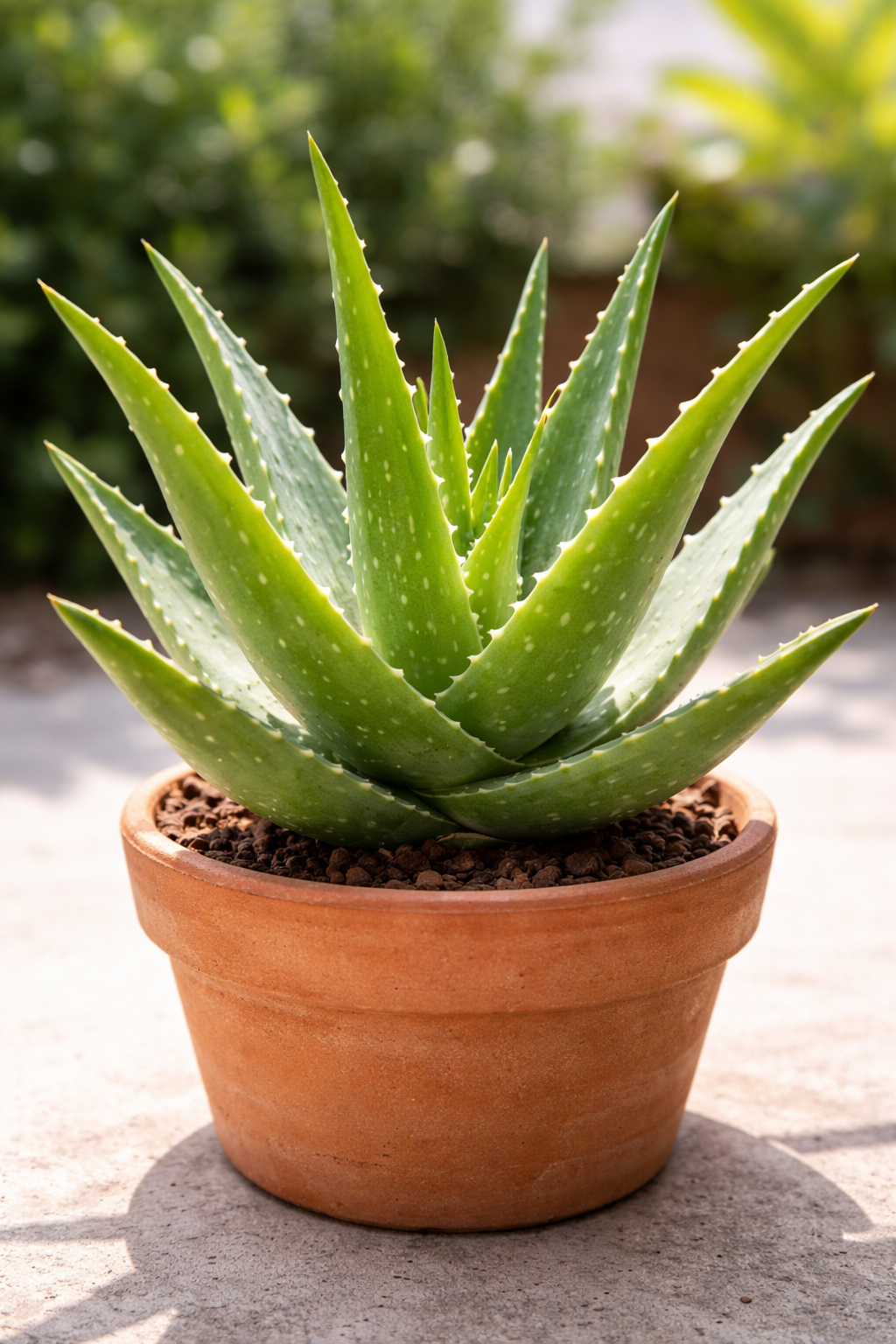
Aloe
Aloe vera
Family: Liliaceae
Perennial herb growing up to 60 cm tall, with short stem and shallow root system. Leaves are large, thick, succulent and pale green with white blotches. Flowers are yellow. Fruits are capsules and are rarely seen.
Common Names:
Kannada: Lolisara
Hindi: Gwar petta, Kambans
English: Aloe, Barbados aloe
Distribution:
Native to Cape Verde and Canary Islands but naturalized elsewhere. Commonly seen along roadsides and waste places under bushes and also largely cultivated.
Agroclimatic Requirements:
It has wide adaptability and can grow in various climatic conditions. It can be grown equally in warm humid or dry climate with an annual rainfall of 35–40 cm to 150–200 cm.
Varieties:
Aloe vera var. chinensis, Aloe vera var. littoralis and Aloe abyssinica.
Cultivation:
It can be propagated by using root suckers.
Propagation:
Medium sized root suckers are chosen and carefully dug out without damaging the parent plant at the base and directly planted in the main field. It can also be propagated through rhizome cuttings. In this case, after harvest of the crop, the underground rhizome is dug out and made into 5–6 cm length cuttings with 2–3 nodes on them. It is rooted in specially prepared sand beds or containers and after it has started sprouting, it is ready for transplanting.
Inputs:
| Sl. No | Materials | Per Acre | Per Hectare |
|---|---|---|---|
| 1 | No. of suckers | 14,550 | 36,500 |
| 2 | Farm Yard Manure (t) | 6 | 15 |
| 3 | Fertilizer (kg) – N | 20 | 50 |
| P2O5 | 20 | 50 | |
| K2O | 20 | 50 |
Planting:
The field should be well prepared before planting. Apply 15 t FYM per hectare 15 days before planting. Open small furrows and apply entire dose of NPK at the time of planting. About 15–18 cm long root suckers or rhizomes are planted at spacing of 60 × 45 cm in such a way that 2/3 portion of the rhizome or sucker should be in the soil. Irrigate the field immediately after planting.
Irrigation and Weeding:
Irrigation must be given according to moisture status and soil type. The land is kept weed free by weeding as and when necessary.
Plant Protection:
Major insect: Mealy bug
Major diseases: Leaf spot, Leaf rot and Anthracnose
Schedule:
1. Spray chlorpyriphos 2 ml in 1 litre of water to control mealy bug.
2. Spray the crop with Bavistin 10 g with Calphomin 3 ml per litre and repeat at 10 days interval for controlling leaf rot and anthracnose.
3. Leaf spot can be controlled by spraying the crop with 0.2% Dithane M-45 at weekly intervals.
Harvesting and Yield:
The crop is ready to harvest about 8 months after planting. The plants can be removed manually. The broken rhizomes left in the soil throw new sprouts to raise the succeeding crop. Aloe plantation gives commercial yield from second year up to 5 years. Thereafter it requires replantation. An average yield of about 10,000–12,000 fresh rhizomes per hectare may be obtained.
Cost of Cultivation:
Approximate cost of cultivation comes around Rs. 42,500/- per hectare.
Part Used:
Juice, Leaves
Medicinal Uses:
1. Used in preparation and for flavoring liquors.
2. Leaf and root juices are used to treat spleen enlargement, stomach disorders, epilepsy, jaundice, tumors, headache and as a coolant.
3. Aloe vera is a source of the drug “Aloin”.
4. Aloe contains cathartic anthrax-glycosides as its active principle ranging from 4.5 to 25% of aloin. These are extensively used as active ingredients in laxative and anti-obesity preparations, as moisturizer, emollient or wound healer in various cosmetic and pharmaceutical formulations.

Reviews
There are no reviews yet.