
Commiphora wightii (Arn.)
Family: Burseraceae
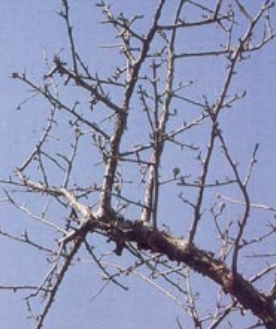
It is a slow growing, highly branched, spiny shrub or small tree with crooked branches ending in sharp spines. A typical desert plant adapted to difficult soil and low moisture conditions. The plant remains leafless during winter (October–March). New leaves sprout in April and persist until September. A short spell of rainfall initiates leaf formation. Guggal, a pale brown to dull green oleo-gum resin, exudes from the bark during winter season.
Common Names:
English: Myrrh
Sanskrit: Guggulu
Kannada: Guggul
Hindi: Guggal
Distribution:
A xerophytic plant growing naturally in arid and rocky zones of Gujarat, Karnataka, Madhya Pradesh and parts of Pakistan.
Agroclimatic Requirements:
Thrives in warm and dry climate. Suitable for arid regions. Sandy or sandy loam soils are ideal. The plant is susceptible to frost and such conditions should be avoided.
Varieties:
Marusudha (from CIMAP). Germplasm from Nakoda (Rajasthan) is also high yielding.
Cultivation:
Propagated through seeds and vegetatively by stem cuttings. Seed germination is poor (about 5%) due to hard seed coat. Seeds are mechanically scarified with sandpaper and soaked in running water for 24 hours. Seedlings are raised in polybags and transplanted to the main field.
Semi-hardwood cuttings (15–20 cm) are planted in nursery beds and irrigated lightly. After 10–12 months, rooted cuttings are transplanted.
Inputs:
| Sl. No | Materials | Per Acre | Per Hectare |
|---|---|---|---|
| 1 | No. of Plants | 1000 | 2500 |
| 2 | Farm Yard Manure (t) | 10 | 25 |
Planting:
Land is prepared before rainy season with 2–3 ploughings and divided into plots. Pits of 0.5 × 0.5 × 0.5 m are dug at spacing of 3 × 3 m. Pits are filled with FYM and topsoil. Rooted cuttings are planted during rainy season. Plants are trained by pruning side branches as they grow.
Irrigation and Interculture:
Light irrigation during summer is beneficial. One weeding and hoeing are required during early growth. Soil around bushes is stirred twice a year.
Plant Protection:
Major insects: Leaf eating caterpillar, White fly and Termites.
Major diseases: Leaf spot and Bacterial leaf blight.
Schedule:
1. During land preparation, mix Chlorpyriphos 0.5 ml per litre of water in pit soil to prevent termites.
2. Spray 0.2% Metacid to control leaf eating caterpillar and white fly.
3. Spray Blitox 4 g + Agromycin 0.1 g per litre of water to control diseases.
Harvesting:
Plants are allowed to grow 5–6 years before tapping. Oleo-gum resin is tapped during winter (November–February) by making 7–10 cm incision near base of main stem. Resin exudes and is collected weekly for about one month until exudation stops.
Yield:
From a 10-year-old plant, about 700–900 g of gum resin can be obtained. This may result in 700–900 kg per hectare yield.
Part Used:
Oleo-gum-resin.
Medicinal Uses:
Guggul oleo-gum resin helps reduce high cholesterol by lowering LDL and increasing HDL levels. It prevents platelet aggregation and helps dissolve blood clots, reducing risk of heart disease and stroke. It is also used as a weight loss agent due to its effect on thyroid function. It stimulates white blood cell activity, enhancing immunity. Used in rheumatism, nervous disorders, urinary diseases and skin conditions. Fumes from burnt guggul relieve cough and lung congestion.
Important preparations include Yogaraja Guggul, Trayodasanga Guggul, Vatari Rasa, Kaisora Guggul, Sadanga Guggul, Amrita Guggul and Kanchanara Guggul.

Reviews
There are no reviews yet.