
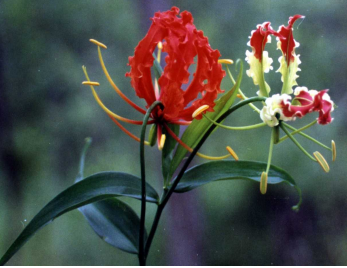
Gloriosa superba Linn.
Family: Liliaceae
Glory lily is a perennial climbing vine crop that remains in the field for several years. It is native to Asia and Africa and is distributed throughout North and South Africa, India, Sri Lanka, Indonesia and neighboring countries. In India, it is commonly found in North-Eastern and Southern states. It is presently cultivated in Tamil Nadu, Andhra Pradesh, Goa and Karnataka mainly for seed production.
Vernacular Names:
Sanskrit: Langalika, Agni Sikha, Garbhagatini, Kalikari
Hindi: Kalihari, Languli, Karihari
English: Superb Lily, Glory Lily
Kannada: Agnisile, Akkatangi Balli, Kolikatumkana Gadde, Gowri Huvu
Telugu: Adavinabhi, Kalapa Gadda, Pottidumpa
Tamil: Kalaipaikizhangu, Kartikkai-kizhangu
Malayalam: Ventoni, Kandal, Manthori-kizhangu
Gujarati: Khadyang
Agro-Climatic Requirements:
Well adapted to various soil types and climatic variations from arid to humid regions. It grows luxuriantly in warm weather with evenly distributed rainfall of about 200 cm annually. Ideal temperature ranges between 15–20°C during day and 10–15°C at night for profuse flowering and seed set. Medium sandy loam soil with pH 6–7 is best suited.
Cultivation:
Plants can be raised from seeds or tubers. Seed treatment with thiourea (0.3–0.4%) improves germination (up to 67.5%). Seed propagated plants take 3–4 years to flower; hence tuber propagation is preferred.
Land is ploughed and harrowed to fine tilth and divided into plots with proper drainage. Tubers are brittle and must be handled carefully. Fungicide-treated apical tuber pieces (50–60 g) are planted at 6 cm depth in furrows spaced 45–60 cm apart. Row spacing is maintained at 30–45 cm. Closer spacing improves cross-fertilization and fruit set. Plant vigor depends on tuber weight.
Intercultural Operations:
Being a tall climber, plants are trained over stakes or wire frames for better fruiting. Copious irrigation is required during dry periods in early growth stage, followed by up to three irrigations per month. Excess moisture may cause tuber rot. Two to three weedings are required.
Manure and Fertilizers:
Apply 15–20 tonnes FYM or compost per hectare during land preparation. Apply 40 kg N, 50 kg P2O5 and 75 kg K2O per hectare at planting, followed by 80 kg N as top dressing 8 weeks after planting along with staking.
Plant Protection:
Major diseases: Leaf blight and tuber soft rot. Spray Dithane M-45 (0.3%) thrice at 10–15 day intervals. Soil drenching with Bavistin (0.2%) or Cuprosol at early stage is effective. Remove and burn infected tubers.
Major pests: Lily caterpillar and green caterpillar. Spray Metacid (0.2%) at fortnightly intervals and dust BHC for control.
Harvesting and Yield:
Pods are manually harvested and shade dried for 7–10 days. Seeds are shade dried for one week and sun dried for another week.
Yield: About 150 kg seeds per hectare in first year; 250–300 kg per hectare from second year onwards. Seeds are packed in moisture-proof containers and stored in cool, dry place.
Cost of Cultivation:
Approximate cost of cultivation is Rs. 2,67,500/- per hectare.
Inputs:
| Sl. No | Materials | Per Acre | Per Hectare |
|---|---|---|---|
| 1 | Tubers (t) | 1 | 2.5 |
| 2 | Farm Yard Manure (t) | 6 | 15 |
| 3 | Fertilizer (kg) – N | 50 | 125 |
| P2O5 | 20 | 50 | |
| K2O | 30 | 75 |
Parts Used:
Tuberous roots.
Medicinal Uses:
Tuberous roots are tonic, anti-periodic, cholagogue, alterative, abortifacient, anthelmintic and purgative. It is one of the eight “Upa Visha” drugs in Ayurveda. Root paste is applied in poisonous insect bites, snake bites, scorpion stings and certain skin diseases. Processed root powder is used in gonorrhea. Root paste applied on suprapubic region promotes labor pains. Leaves paste controls lice infestation. Seeds are used in preparation of medicines for gout.

Reviews
There are no reviews yet.