
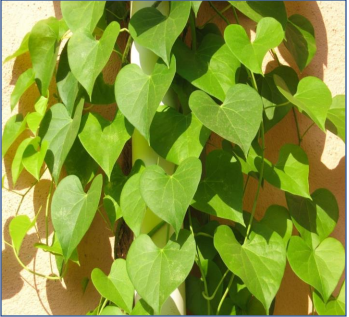
Giloe
Tinospora cordifolia Miers
Family: Menispermaceae
A large, extensively spreading perennial woody climber with succulent stems. Leaves simple, alternate and cordate-ovate. Flowers unisexual, dioecious and yellow. Fruits consist of three shortly stalked, subglobose drupes.
Common Names:
Guduchi, Amrita, Gurach, Tinospora
Sanskrit: Amrita, Guduchi, Chchinna, Amritavalli, Amritavallari
Kannada: Amrita Balli
Hindi: Guduchi, Giloy, Gulancha
English: Tinospora, Gurjo, Heart-leaved Moonseed
Tamil: Seenthal
Telugu: Tippa Teega
Distribution:
Occurs throughout tropical regions of India extending from Kumaon to Assam and Myanmar, and from Bihar and Konkan to Sri Lanka. It is a large climber that grows over tall forest trees and produces aerial roots up to 10 metres long, though slender in thickness.
Part Used:
Stem.
Cultivation:
Soil and Climate:
Grows well in almost all types of soils and under varying climatic conditions.
Nursery Raising and Planting:
Propagated through stem cuttings during May–June. The plant requires support, preferably Neem or Mango trees, as such hosts are believed to enhance medicinal value.
Weeding and Hoeing:
Periodic hoeing is carried out both in nursery and main field as required.
Manures, Fertilisers and Pesticides:
The crop should be grown without chemical fertilizers and pesticides. Organic manures such as Farm Yard Manure (FYM), Vermi-compost and Green manure may be applied as needed. Bio-pesticides prepared from Neem (kernel, seeds and leaves), Chitrakmool, Dhatura and Cow’s urine may be used for disease prevention.
Irrigation:
After planting, irrigation should be provided weekly or fortnightly depending on requirement.
Harvesting / Post-Harvesting Operation:
Mature stems are collected, cut into small pieces and shade dried.
Yield:
Approximately 8–10 quintals per hectare.
Economics (Year – 2001):
The rate for 1 kg of dried stem ranges from Rs. 15–20.
Note: Market for medicinal plants is volatile and economics may vary.

Reviews
There are no reviews yet.