
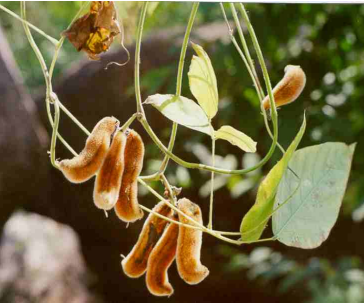
Mucuna prurita Hook.
Synonyms: Mucuna pruriens Baker; Carpogon pruriens; Dolichos pruriens
Family: Leguminosae
An herbaceous twining annual found almost all over India including Andaman and Nicobar Islands. Leaves trifoliate; leaflets broadly ovate, elliptic or rhomboid-ovate, unequal at base. Flowers borne in axillary pendulous racemes, purple in colour. Pods curved, 5–10 cm × 1.5–1.8 cm, longitudinally ribbed, turgid and densely clothed with persistent pale brown or grey irritant bristles. Seeds black, 4–6 per pod, ovoid with funicular hilum.
Distribution:
Found in bushes and hedges, damp places, ravines and scrub jungles throughout the plains of India, mainly in West Bengal, Madhya Pradesh, Karnataka, Kerala, Uttar Pradesh and Andaman & Nicobar Islands. Occasionally cultivated. Reported as a pest in Sal plantations of Bengal.
Vernacular Names:
Sanskrit: Aatmagupta, Kapikacchu, Vanari
Hindi: Kiwach, Kaunch, Goncha
Bengali: Alkushi, Bichoti
Kannada: Nasugunni Kai, Turuche Gida
Telugu: Dulagondi, Pilliadugu
Tamil: Poonaipidukkan, Poonaikalei
Malayalam: Naicorna
Agro-Climatic Requirements:
A hardy plant growing in a variety of well-drained soils. Suitable for tropical and subtropical regions. Can be grown throughout the year if irrigation is available. Does not tolerate excessive cold and fog.
Cultivation:
For rainfed crop, seeds are sown in June and harvested in December. Under irrigated conditions, sowing is done in August and harvesting in February. Seeds are directly sown at a rate of 5 kg/ha. Land is ploughed 2–3 times to fine tilth and manured with 10 tonnes of FYM or compost before sowing. Seeds are sown at spacing of 60 cm in patches or hills. Plants are staked when a few inches tall. If sown at 45 × 60 cm spacing, plants may trail on ground without support. Light irrigation is given soon after sowing.
Manure and Fertilizers:
Per hectare requirement: 100 kg Nitrogen, 80 kg Phosphorus and 40 kg Potash. Phosphorus is applied during land preparation. Nitrogen and Potash are given in two split doses at 30 and 60 days after sowing.
Intercultural Operations and Irrigation:
Weeding is carried out at 15–20 day intervals initially. After 60 days, the crop spreads and weeding becomes difficult. In irrigated crop, irrigation is given before sowing, just after germination and 4–6 times at 20–25 day intervals during November and December.
Plant Protection:
Generally free from major pests and diseases. At later stages, leaf eating insects and leaf spot disease (caused by Cercospora) may occur. Insects can be controlled by spraying 0.2% Malathion or Metacid at 15-day intervals. Dithane M-45 (0.3%) is sprayed at 7-day intervals to control leaf spot disease.
Harvest and Yield:
Crop is harvested 170–180 days after sowing. Fully mature fruits are harvested 3–4 times per season. If not harvested timely, pods dry and split, causing seed loss. Fruits are dried in sunlight, seeds separated, dried and stored.
Seed yield of irrigated and supported crop: 3000–4000 kg/ha.
Seed yield of rainfed and trailing crop: 1500–1750 kg/ha.
Inputs:
| Sl. No | Materials | Per Acre | Per Hectare |
|---|---|---|---|
| 1 | Seeds (kg) | 20 | 50 |
| 2 | Farm Yard Manure (t) | 6 | 15 |
| 3 | Fertilizer (kg) – N | 40 | 100 |
| P2O5 | 32 | 80 | |
| K2O | 30 | 75 |
Parts Used:
Roots, seeds and bristly hairs.
Medicinal Uses:
Roots are tonic, stimulant, diuretic, purgative and emmenagogue. Used in nervous disorders such as facial paralysis and hemiplegia, kidney troubles and dropsy. Ointment from root is applied in elephantiasis. Seeds are astringent and tonic with mild insecticidal activity. Seed powder (20–40 grains) is prescribed in leucorrhoea and spermatorrhoea and acts as aphrodisiac. Vanari Kalpa and Vanari Gulika are reputed aphrodisiac preparations. Leaves are applied to ulcers. Bristly hairs from pods cause intense itching and are used medicinally as vermifuge when administered with honey or syrup followed by purgative.

Reviews
There are no reviews yet.