
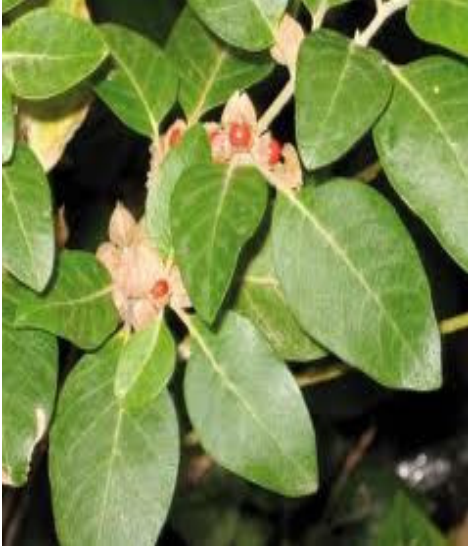
Ashwagandha
Withania somnifera (Linn.) Dunal
Family: Solanaceae
An erect, branched undershrub up to 1.25 m in height, with minute, smooth and shiny hairs throughout the plant. Leaves are ovate, hairy and soft to touch. Flowers are greenish. Roots are fleshy, tapering and whitish-brown in colour. Leaves and roots are narcotic in large doses.
Common Names:
Sanskrit: Ashwagandha
Hindi: Asgandh
English: Winter Cherry, Indian Ginseng
Kannada: Hiremaddina gida, Asvagandhi
Tamil: Amukkira, Asuvagandhi
Telugu: Pennerugadda, Panneru, Vajigandha
Malayalam: Pevette
Distribution:
Globally distributed from Africa and the Mediterranean region to India and Sri Lanka. In India, it is distributed in the sub-Himalayan tracts up to an altitude of 1000 m and throughout the drier subtropical regions such as Rajasthan, Punjab, Haryana, Uttar Pradesh, Gujarat, Maharashtra and Madhya Pradesh. In Karnataka, it is found in large quantity in Talacauvery.
Agroclimatic Requirements:
This species grows in subtropical and tropical climates and prefers dry weather. Annual rainfall of 600–750 mm is best suited. One to two late winter rains are sufficient for proper root development. Sandy loam or light red silt soil rich in organic matter is ideal. Soil pH should be between 7.5–8.0 with good drainage.
Varieties:
Poshita, Jawahar Asgandh-20, Jawahar Asgandh-134.
Cultivation:
It is propagated through seeds.
Seed Propagation:
Flowering occurs during July–September and fruiting in November–December. Seeds are washed to remove mucilage and dried in sunlight. Before sowing, seeds are soaked in cold water for 24 hours. Seeds are directly sown in the main field by broadcasting and lightly covered with soil. They may also be sown in sunken beds at 5 cm spacing. Sowing is done during October–January or July–September. Germination occurs within 6–7 days with about 80% germination.
Transplanting and Aftercare:
Seedlings are transplanted at 6 weeks of age during late rainy season in rows spaced 60 cm apart. Excess seedlings are thinned 25–30 days after sowing to maintain a population of about 20,000–25,000 plants per hectare. Hand weeding at 30-day intervals is necessary to control weeds.
Inputs:
| Sl. No | Materials | Per Acre | Per Hectare |
|---|---|---|---|
| 1 | Seeds (kg) | 2–5 | 5–12 |
| 2 | Farm Yard Manure / Fertilizer | No manure or fertilizers recommended; crop can be grown on residual fertility | |
Plant Protection:
Major insect: Shoot borer and mite.
Major diseases: Seed rotting, Seedling blight and Leaf blight.
Schedule:
• To control mite, spray ethion 10 ml per litre as soon as mites are noticed.
• Shoot borer can be controlled with Sumicidin at 10 ml per litre.
• Treat seeds before sowing with Captan @ 5 g per kg of seed and drench Calphomin @ 3 ml per litre in nursery before sowing.
• Spray Dithane M-45 @ 3 g per litre of water when the crop is 30 days old and repeat at 15-day intervals if diseases persist.
Harvest and Yield:
Harvesting starts from January and continues till March. The entire plant is uprooted for roots, which are separated from aerial parts by cutting the stem 1–2 cm above the crown. Roots are cut into 7–10 cm pieces to facilitate drying. Berries plucked from dried plants are threshed to obtain seeds. Maturity is judged by drying of leaves and red berries.
Yield: 600–800 kg roots and 50 kg seeds per hectare.
Cost of Cultivation:
Approximate cost of cultivation comes around Rs. 25,000/- per hectare.
Parts Used:
Leaves and Roots.
Medicinal Uses:
The root powder is used to treat consumption, excessive emaciation, bronchial asthma, rheumatic ailments, insomnia, cardiac diseases, wounds, suppression of urine and sterility. Root powder mixed with honey and ghee in equal parts is recommended for impotence or seminal debility. For improving sight, a mixture of Ashwagandha root powder, liquorice powder and juice of amalaka is recommended for internal administration. For lumbago and knee pain, root powder with sugar candy in ghee is advised. Combination of Mandukaparni (Centella asiatica), Sankhapuspi (Convolvulus microphylla), Ashwagandha and Satavari (Asparagus racemosus) is used to promote intellect, vitality, stability and strength. Powder of sugar, Ashwagandha and Pippali (Piper longum) mixed with ghee and honey is used for rejuvenation and in spermatorrhoea.

Reviews
There are no reviews yet.