
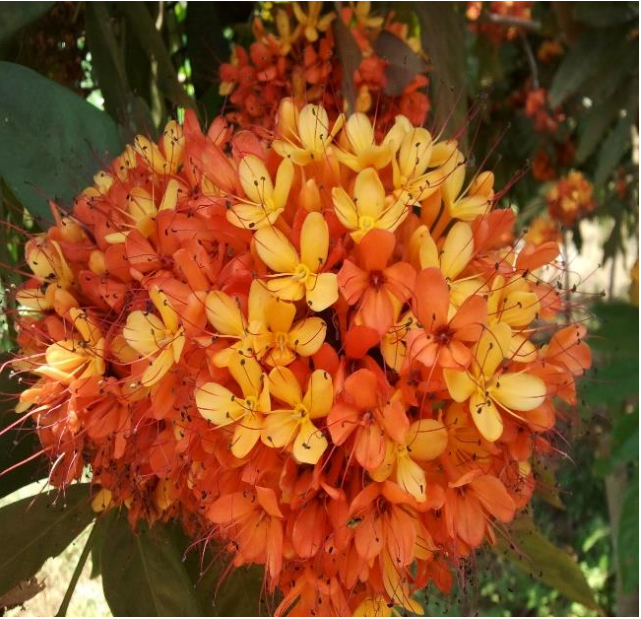
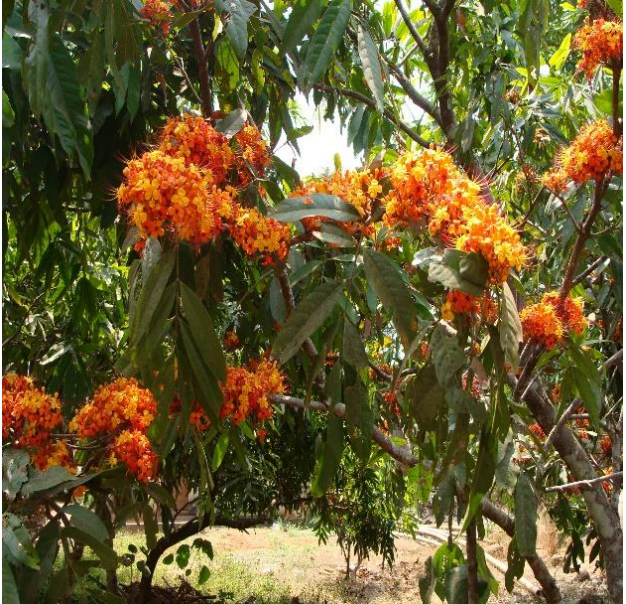
Ashok, Sita Ashok
Botanical Name: Saraca asoca
Family: Caesalpiniaceae (Gulmohar family)
Synonyms: Jonesia asoka
Ashok is a small evergreen tree 6 to 9 m high. Leaves paripinnate, 15–20 cm long; leaflets 6–12, oblong-lanceolate; flowers orange or orange-yellow and very fragrant; pods flat and leathery; seeds 4–8, ellipsoid-oblong.
Common Names:
English: Ashok, Sita Ashok
Hindi: Sita Ashok, Ashok
Kannada: ಆಚಂಗೆ (Achange), ಅಚೆಂಗ (Achenga), ಅಶೋಕ (Ashoka)
Distribution:
It is found wild along streams or in the shade of evergreen forests. It occurs almost throughout India up to an altitude of 720 m in the central and eastern Himalayas and Khasi, Garo and Lushai hills. It is also found in the Andaman Islands.
Part Used:
Stem bark.
Cultivation:
Soil and Climate:
The plant requires slightly acidic to neutral soils for good growth with medium to deep, well drained fertile soils. It grows well in tropical to sub-tropical situations under irrigation.
Nursery Raising and Planting:
The crop can be propagated by seeds and stem grafting. The seedlings are planted in the well manured field during the rainy season.
Thinning and Weeding:
Weeding and thinning of the plants may be done as and when required, usually after 15–30 days, for better growth.
Manures, Fertilisers and Pesticides:
The medicinal plants have to be grown without chemical fertilizers and use of pesticides. Organic manures like Farm Yard Manure (FYM), Vermi-compost, Green Manure etc. may be used as per requirement of the species. To prevent diseases, bio-pesticides could be prepared (either single or mixture) from Neem (kernel, seeds and leaves), Chitrakmool, Dhatura, Cow’s urine etc.
Irrigation:
Normally grown as a rainfed crop, but for better yield irrigation may be done as per requirement (weekly or fortnightly).
Harvesting / Post Harvesting Operation:
Bark is removed from about ten years or more old tree and then it has to be sun dried.
Economics:
The rate for a kg of dried bark ranges from Rs. 120–150 (Year – 2001).
Note: Market for medicinal plants is volatile and the economics may vary.
Medicinal Uses:
The juice obtained from boiling the bark is used in treating certain ailments of women. A pulp of the blossoms is used as one of the remedies for dysentery.

Reviews
There are no reviews yet.