
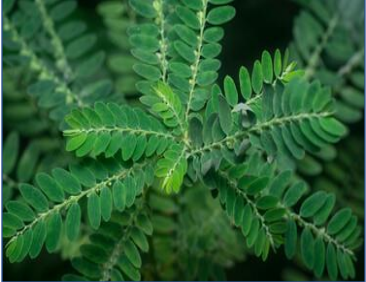
Bhumi Amalaki
Phyllanthus amarus Schum. and Thonn.
Family: Euphorbiaceae
The plant grows abundantly throughout India up to 700 m altitude during the rainy season, however with less frequency in the southern part of the country. It is a small erect annual herb 10–60 cm tall. Leaves are small, elliptic-oblong; flowers whitish-green and minute.
Common Names:
Tamalaki, Hazardana, Jarmala, Jangli Amala
Hindi: Jangli Amlai, Bhumi Amla
Sanskrit: Tamalaki, Bahupatra
Kannada: Nelanelli, Bhu Nelli, Bhumi Amla
Tamil: Kilanelli
Telugu: Nela Usiraka
English: Stonebreaker, Seed-under-leaf
Location:
Uttar Pradesh, Haryana, Punjab, Maharashtra, Tamil Nadu, Kerala, Andhra Pradesh, Karnataka, Bihar, Orissa and Bengal.
Part Used:
Whole plant.
The biomass morphologically resembling species Phyllanthus fraternus Webster and Phyllanthus niruri L. is also used as Bhumi Amalaki. Their cultivation techniques are almost similar.
Cultivation:
Soil and Climate:
Bhumi Amalaki is well adapted to a variety of soils, with soil pH ranging from alkaline to neutral and acidic. Plants prefer calcareous, well drained and light textured soils. It is a circum-tropical weed and grows well under tropical conditions. It rarely survives under dry or very low temperature conditions, but waterlogging does not show lethal effects.
Nursery Raising and Transplanting:
The crop is propagated through seeds. About 1 kg of seeds is sufficient to raise seedlings for transplanting one hectare. Seeds are sown in well prepared nursery beds. Well decomposed Farm Yard Manure is mixed with the top soil layer while preparing the beds. Being minute, seeds are mixed with dry soil or sand for uniform distribution. A thin layer of soil is spread to cover the beds and adequate moisture is maintained until germination. In north Indian plains, April–May is suitable for higher germination and good herb yield.
Approximately 15–30 day old seedlings (about 10 cm tall) are transplanted in the field at spacing of 15 × 15 cm. Irrigation immediately after transplanting ensures proper establishment. Transplanted crop gives improved herbage yield.
Weeding:
The field should be kept weed free through regular monthly hand weeding. Spraying of commercial herbicides is not desirable as they may deteriorate the crop and leave residual effects in the crude drug.
Manures, Fertilisers and Pesticides:
The medicinal crop should be grown without chemical fertilizers and pesticides. Organic manures such as Farm Yard Manure (FYM), Vermi-compost and Green manure may be applied as required. To prevent diseases, bio-pesticides prepared from Neem (kernel, seeds and leaves), Chitrakmool, Dhatura, Cow’s urine etc. may be used.
Irrigation:
In southern regions with frequent rainfall during rainy season, irrigation may not be required. In northern plains with less rainfall, one irrigation per fortnight is necessary. Waterlogging is generally not a problem for this plant.
Harvesting / Post-Harvesting:
Plants are harvested at the end of rainy season while still green and herbaceous. Since active constituents are concentrated more in the leaves, production of higher leaf biomass is desirable. Plants harvested in September contain maximum leaves and are considered suitable for harvesting.
Economics (Year – 2001):
Expenditure per hectare: Rs. 5,000/-
Return per hectare: Rs. 20,000/-
Net income: Rs. 15,000/-
Note: Market for medicinal plants is volatile and economics may vary.


Reviews
There are no reviews yet.