
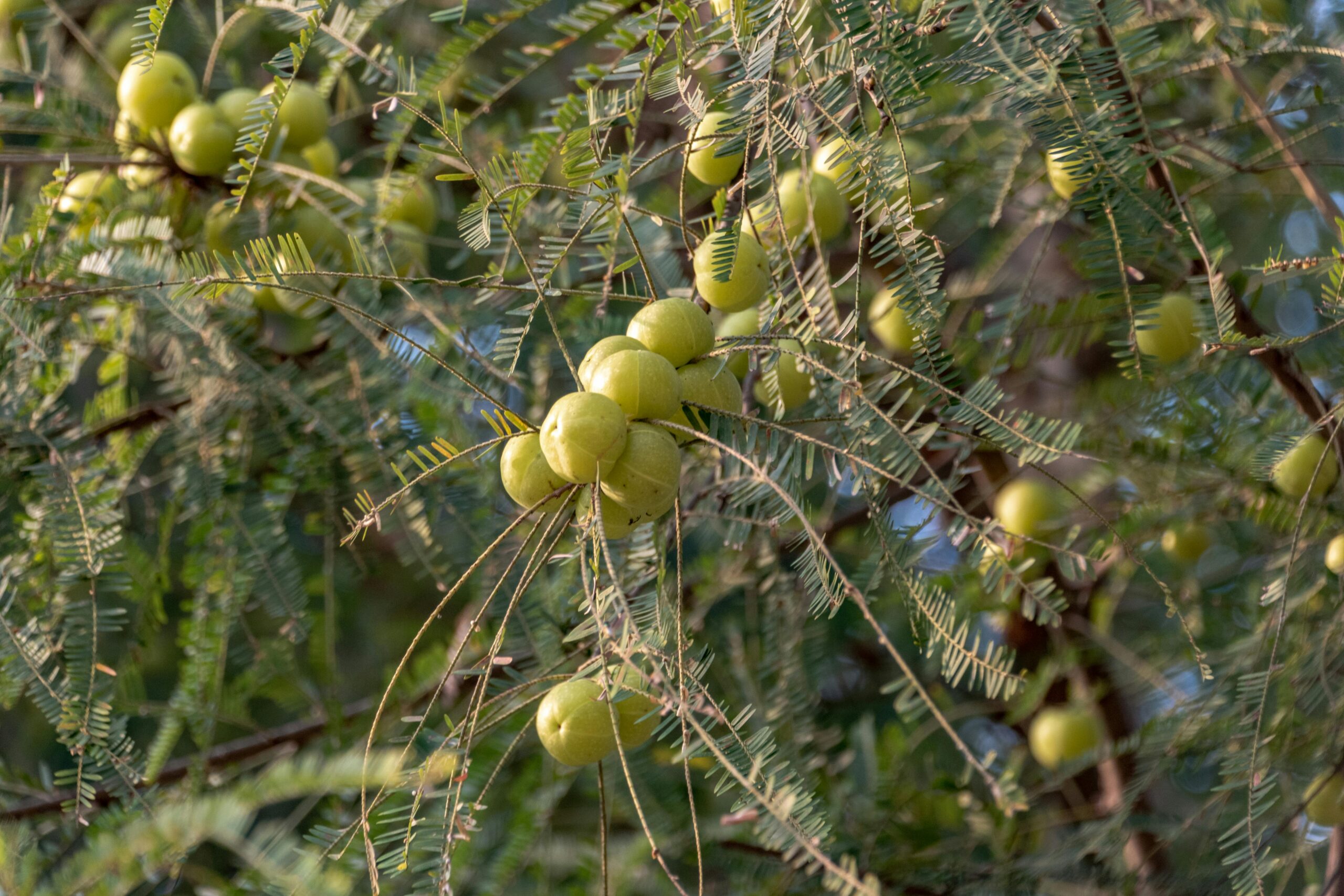
Amla
Phyllanthus amarus
Syn: Emblica officinalis Gaertn.
Family: Euphorbiaceae
A small to medium sized deciduous tree, 8–18 m in height with crooked trunk and spreading branches. Leaves simple, subsessile; flowers greenish to yellow; fruits nearly spherical, pale yellow with vertical furrows.
Common Names:
English: Indian Gooseberry
Kannada: Amalaka, Nelhi
Hindi: Amla, Aonla
Tamil: Nelhi
Telugu: Usirikai, Usirika
Distribution:
This species is probably native to America, now naturalized in the tropics of the world. Wild or planted throughout the deciduous forests of tropical India, it is found on hill slopes and throughout the warmer parts of India.
Agro Climatic Requirements:
Soil: It is well adapted to a variety of soils, at soil pH ranging from alkaline to neutral and acidic soils. Plants have shown preference for calcareous, well drained and light textured soils. Plants do not grow properly under shade.
Climate: It grows under semi-temperate to tropical conditions and under high rainfall. However, it rarely survives under dry or very low temperature conditions. Water logging does not show any lethal effects on this crop.
Varieties:
A selection named “Navyakrit” from CIMAP, Lucknow has been found superior to get high herbage yield and active constituents.
Cultivation:
It can be propagated using seeds.
Seed Propagation:
Sowing Method: The seeds are sown in well-prepared nursery beds. Well-decomposed Farm Yard Manure should be mixed with the top layer of the soil while preparing the beds. Being minute, the seeds are mixed with dry soil or sand to allow uniform distribution on the nursery bed. Later, a thin layer of soil is spread to cover the beds. Appropriate moisture is maintained till germination.
Sowing Season: Sowing in April–May gives higher seed germination and good yield.
Transplanting:
30–40 day old seedlings, which are 10–15 cm tall, are transplanted at a spacing of 15 × 15 cm. Irrigation soon after transplanting ensures good establishment of the seedlings.
Plant Protection:
Major insects: Leaf eating caterpillar and stem weevils
Major disease: Powdery mildew
Schedule:
1. Spray the plants with 0.2% Nuvacron to control insect pests.
2. Powdery mildew can be effectively controlled by applying sulphur containing fungicide like Sulphex @ 0.25%.
Harvest and Yield:
The crop is ready for harvest after 3 months of transplanting when the plants are greenish and herbaceous. As the crop grows, there is an increase in biomass but the quantity of leaves is reduced due to fall of lower leaves. Since major active ingredients are confined to the leaves, production of maximum leaf biomass is the aim of harvesting at the appropriate time. Under Bangalore conditions, September has been found to be the optimum time of harvesting for high drug yield. The herb is shade dried for 3–4 days with constant raking. After drying, the material is stored in gunny bags and kept in a cool, dry place.
The yield of herb varies with spacing. By adopting a spacing of 15 × 10 cm, an average yield of 2000 kg of dry herb per hectare can be achieved. The total Phyllanthin content in herb may range from 0.4% to 0.5%.
Cost of Cultivation:
Approximate cost of cultivation comes around Rs. 62,500/- per hectare.
Inputs:
| Sl. No | Materials | Per Acre | Per Hectare |
|---|---|---|---|
| 1 | Seeds (kg) | 0.4 | 1.0 |
| 2 | Farm Yard Manure (t) | 4 | 10 |
| 3 | Fertilizer (kg) – N | 60 | 150 |
| P2O5 | 24 | 60 | |
| K2O | 24 | 60 |
Part Used:
Whole plant – fruit, seed, leaves, root, bark and flowers.
Medicinal Uses:
Amla is an antioxidant with free radical scavenging properties, which may be due to the presence of high levels of superoxide dismutase. It is effective in the treatment of peptic ulcer, dyspepsia, jaundice, leucorrhoea (Pradara), diabetes etc. Further reported properties include hepatoprotective, antioxidant, antimutagenic, cytoprotective, antitumour and antimicrobial activities.


Reviews
There are no reviews yet.