
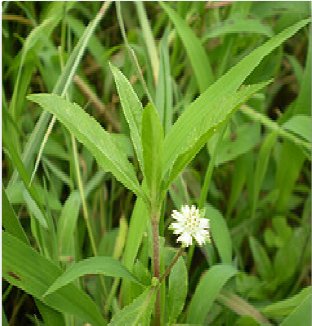
Eclipta alba Hassk.
Family: Asteraceae
Common Names:
Hindi: Bhagra, Babri, Bhangra, Mochkand, Bhrangraj, Jalmagra, Bhangro, Jal-bhangro
Kannada: Garagadasappu, Kadiggagaraga, Kaadige Garike, Ranjana
Sanskrit: Ajagara, Angaraka, Bhekaraja, Bhringa, Bhringaraja, Bhringavha, Brnga, Brngaja
Tamil: Kaikeshi, Karisalankanni, Karisirang Kanni
Telugu: Galagara
Distribution:
A pantropical species found in Indonesia, Sri Lanka, India, Philippines, Nepal, Laos, Kampuchea, Pakistan, Thailand, Vietnam, Malaysia and Myanmar (earlier Burma). It is distributed throughout India at all elevations. Within India, it is a common weed in moist situations and disturbed habitats such as roadsides and wastelands, ascending up to 1800 m on hills.
Agroclimatic Requirements:
It is a shade loving plant which prefers damp to wet soil and grows well on clayey soils. Red loamy soils rich in organic matter are best suited. The crop is hardy and grows in tropical, subtropical and temperate regions. However, it prefers a warm climate with a temperature range of 25°C to 35°C for good growth and yield.
Varieties:
No named varieties in this crop.
Cultivation:
It can be propagated through seeds or cuttings.
Seed Propagation:
Seeds are sown in nursery beds of size 1 × 3 × 0.15 m. Soil is prepared up to 30 cm depth and mixed with Farm Yard Manure at the rate of 2 kg/m² along with a little sand. Seeds are sown in rows about 6 cm apart, gently covered with soil and watered using a sprinkler.
Vegetative Propagation:
Terminal cuttings with 5–6 nodes and 10–15 cm length are planted in well prepared nursery beds or polythene bags.
Inputs:
| Sl. No | Materials | Per Acre | Per Hectare |
|---|---|---|---|
| 1 | Seeds (kg) | 1 | 2.5 |
| 2 | Farm Yard Manure (t) | 8 | 20 |
| 3 | Fertilizer (kg) – N | 30 | 75 |
| P2O5 | 30 | 75 | |
| K2O | 20 | 50 |
Transplanting and Aftercare:
Seedlings are ready for transplanting at 30–40 days old. In vegetative method, transplanting into the main field is done after 4–6 weeks when rooting is complete, at a spacing of 30 × 45 cm.
Irrigation and Interculture:
After transplanting, irrigation should be provided twice a week for one month. Later, irrigation is given weekly depending on rainfall and soil moisture status.
Plant Protection:
Major insect: Nil
Major diseases: Yellowing, Leaf blight and Gall bladder.
Schedule:
Spray the crop with 0.2% Mancozeb.
Harvest and Yield:
Harvesting is done by uprooting the plant. Roots are chopped off. Fresh plant material should not be heaped or packed in bags. If possible, cut the material into moderate pieces to aid proper drying. Shade drying is preferred and material should be spread uniformly.
Cost of Cultivation:
Approximate cost of cultivation comes around Rs. 40,000/- per hectare.
Parts Used:
Whole plant and seeds.
Medicinal Uses:
The whole plant and seeds are used in the form of oil, powder and juice to treat filariasis, boils, wounds, headache, giddiness, poor vision, indigestion, enlargement of liver and spleen, jaundice, abdominal pain, cough, skin diseases and fever.
Greying of Hair:
Oil (160 ml) is cooked with the juice of Bhringaraja and milk (1.28 litres) along with paste of Madhuka (Glycyrrhiza glabra) 40 g. It is used as snuff and applied on head to prevent greying of hair.
Rejuvenative / Rasayana:
Powder containing Bhringaraja leaves, Black sesamum, Amalaka (Phyllanthus emblica) and sugar in equal quantity (10–15 g) acts as a rejuvenative / rasayana.


Reviews
There are no reviews yet.