
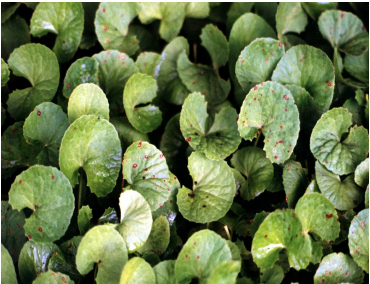
Centella asiatica Linn.
Syn: Hydrocotyle asiatica Linn.
Family: Apiaceae (Umbelliferae)
A prostrate, faintly aromatic, stoloniferous perennial herb extending up to 2 m long. Commonly found as a weed in crop fields and waste places throughout India up to 600 m altitude. Stem glabrous, pink and striated, rooting at nodes. Leaves fleshy, orbicular-reniform, crenate-dentate, cordate at base, long petioled, smooth above and sparsely hairy beneath. Flowers red, pink or white in fascicled umbels. Fruits oblong, dull brown, laterally compressed with hard woody pericarp.
The plant has high reputation in indigenous medicine and is often confused with Bacopa monnieri (Brahmi). However, Brahmi refers to B. monnieri, while Centella asiatica is known as Mandukaparni.
Vernacular Names:
Sanskrit: Mandukaparni, Brahmamanduki, Manduki
Hindi: Brahma-manduki, Khulakhudi, Mandookaparni
English: Indian Pennywort
Kannada: Vandelaga, Brahmisappu
Gujarati: Moti Brahmi
Telugu: Saraswataku
Tamil: Vallarai
Malayalam: Kodangal, Muyalchevi
Distribution:
Distributed throughout India, Sri Lanka, China, Australia, Indonesia and Malaysia. Used as a cover crop in plantations and recommended for preventing surface run-off on slopes.
Threat Status: Under cultivation.
Agro-Climatic Requirements:
Grows abundantly on moist sandy or clayey soils forming dense green mats. Can grow in almost any soil with adequate moisture. Soil pH range: 6.0–9.0.
Varieties:
Majjaposhak, Kayakirti, Lucknow Local.
Cultivation:
Propagated through seeds and stolon cuttings. Land is prepared with 4–6 ploughings and brought to fine tilth. Fields are leveled and divided into small irrigation compartments. Seeds are broadcast or drilled. Stolon cuttings with at least one node are planted horizontally at 30 × 30 cm spacing during October. Providing partial shade increases active constituent content. First irrigation immediately after planting, followed by irrigation at 8–10 day intervals. Initial weeding at 15–20 days interval, later as required.
Manure and Fertilizer:
Apply 5 tonnes FYM per hectare. For vegetative growth apply 100 kg Nitrogen in 3 splits, along with 60 kg P₂O₅ and 60 kg K₂O per hectare at land preparation.
Plant Protection:
No major serious pests or diseases reported.
Harvesting and Yield:
Leaves are harvested at 15-day intervals from January onwards. Harvesting should be completed before monsoon (June). Leaves are shade dried or pre-treated at 80°C for 30 minutes before shade drying. Yield per hectare: 54 quintals fresh leaves (20 quintals dry leaves), yielding approximately 20 kg asiaticoside.
Cost of Cultivation:
Approximately Rs. 40,000/- per hectare.
Inputs (Per Hectare):
Number of plants: 112,000
Farm Yard Manure: 5 tonnes
Fertilizers: N – 100 kg, P₂O₅ – 60 kg, K₂O – 60 kg
Parts Used:
Whole plant – leaves, fruit, root, seeds and stem.
Medicinal Uses:
Leaves are consumed as vegetable in Karnataka and Kerala. Widely used internally and externally in traditional medicine for skin diseases such as eczema, psoriasis, leprosy, syphilitic conditions, malaria, fevers, epilepsy and memory enhancement. Used in forms such as fresh juice (Swarasam) and medicated ghee (Ghrutam). Clinical studies indicate improvement in concentration and cognitive function. Also used in cholera, rheumatism, elephantiasis and hydrocele. Externally applied as ointment or powder for skin disorders. Internally acts as tonic and is used in bronchitis, asthma, kidney disorders and dropsy. In large doses, may act as narcotic causing headache, vertigo and coma. Considered aphrodisiac and used in venereal diseases.


Reviews
There are no reviews yet.