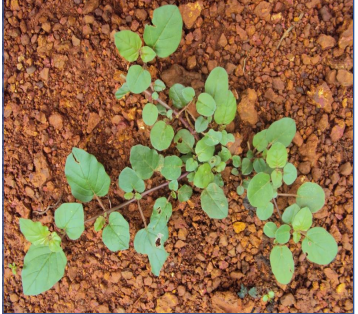
Punarnava
Boerhaavia diffusa Linn.
Family: Nyctaginaceae
A very variable, diffusely branched, prostrate herb, either pubescent or glabrous. Rootstock stout, fusiform and woody. Stems creeping, often purplish and swollen at nodes. Leaves oblong-cordate, entire or sinuate, whitish and smooth beneath, rough green above. Flowers red, pink or white in small umbels. Anthocarps pubescent, five-ribbed, viscid and glandular.
Distribution:
Commonly occurs as a rainy-season weed throughout India, up to 2,000 m altitude in the Himalayas. Cultivated to some extent in West Bengal.
Common Names:
Sanskrit: Punarnava, Shotagni
English: Spreading Hog Weed
Hindi: Gandhaparna, Thikri, Sant
Kannada: Sanadika, Gonajali
Telugu: Attatamamidi
Tamil: Talutama
Malayalam: Tamilama, Talutama
Gujarati: Vakha-khaparo
Parts Used:
Whole plant.
Varieties:
Two types are recognized:
• Rakta Punarnava – Red-flowered variety
• Sweta Punarnava – White-flowered variety
Cultivation:
Widely distributed in tropical and subtropical regions and naturalized in some temperate zones. Prefers sunny locations and well-drained soils but grows in various soil types. Common in cultivated fields and wastelands. After mechanical cultivation, it resprouts from roots, though repeated cultivation can exhaust the plant.
Harvesting:
Plants begin flowering as early as 4 weeks from seed. Flowering and fruiting occur year-round if adequate moisture is available.
Medicinal Uses:
The plant possesses bitter, stomachic, laxative, diuretic, expectorant, diaphoretic and emetic properties. The root is purgative, anthelmintic and febrifuge.
The white variety is used in oedema, anaemia, heart diseases, cough and intestinal colic. The red variety is beneficial in oedema, haemorrhage, anaemia and bilious conditions.
Paste of the plant is applied in leprosy and skin disorders. Decoction is used for kidney stones and oedema. Root paste is applied in rat bite, eye diseases, insomnia and rheumatism. Plant juice is used in jaundice, liver cirrhosis, ascites, urethritis and asthma. Leaf juice with honey is applied in chronic ophthalmia. It is administered internally as a blood purifier and for relief of muscular pain.
Traditional formulations such as Punarnavastaka Kashayam are used in general oedema, nephritic syndrome, jaundice and respiratory disorders. Punarnava Madura is indicated in anaemia and oedema. Punarvadi Kashayam is beneficial in urinary disorders including burning micturition and urinary calculi. Root decoction is used in gonorrhoea and internal inflammatory conditions.


Reviews
There are no reviews yet.