
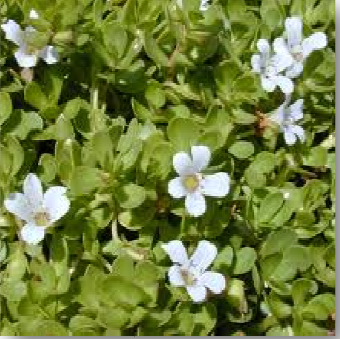
Bacopa monnieri
Family: Scrophulariaceae
Brahmi is a reputed intellect promoter, hypotensive and neuropathic sedative drug. It is a fleshy creeping herb that branches profusely and starts rooting at the nodes. Leaves are simple, opposite, arranged one above the other and perpendicular to each other, without petiole and oblong in shape. Flowers are pale blue to whitish, situated singly at the leaf axis.
Common Names:
Sanskrit: Brahmi
English: Thyme-leaved Gratiola
Kannada: Niru Brahmi
Hindi: Brami, Jalnim
Tamil: Nirpirami, Piramiyapundu
Distribution:
The plant is commonly found in moist and damp areas on the edges of streams and water trenches and in crop fields up to an altitude of 1300 m. It is distributed throughout India and adjoining countries.
Threat Status:
Traded species.
Agroclimatic Requirements:
The plant grows in a variety of soil types provided the habitat is wet and semi-shaded. Neutral, clayey loam to clayey soils are best suited for its growth.
Propagation:
It is propagated mainly through vegetative means.
Vegetative Propagation:
Whole plant can be cut into small units with 4–6 nodes each and used for propagation. Cuttings are soaked in slurry water to hasten rooting and planted directly in the field. Plantlets sprout and establish readily.
Varieties:
Two varieties, Pragyashakti and Subodhak (high herbage and Bacoside-A content), have been released by CIMAP, Lucknow.
Inputs:
| Sl. No | Materials | Per Acre | Per Hectare |
|---|---|---|---|
| 1 | Seeds (kg) | 1 | 2.5 |
| 2 | Farm Yard Manure (t) | 8 | 20 |
| 3 | Fertilizer (kg) – N | 40 | 50 |
| P2O5 | 30 | 75 | |
| K2O | 12 | 30 |
Cultivation:
The plant is usually propagated by softwood stem cuttings. For mass propagation, whole plants are cut into small divisions and planted directly in sunken beds. Cuttings of 5–6 cm length with a few leaves and nodes establish easily. They are transplanted in wet soil at 10 × 10 cm spacing for maximum yield. Immediate irrigation after planting ensures survival. The plant grows rapidly at temperatures of 33–40°C and humidity of 65–80%, and is best cultivated as a summer–rainy season crop. Transplanting during July–August gives maximum yield.
Irrigation:
Watering is essential immediately after transplanting. Subsequently, irrigation is provided at 7–8 day intervals. Irrigation should be avoided during heavy rainy season.
Interculture:
Hand weeding at 15–20 day intervals is required initially. Later, as plants form a dense mat, occasional weeding is sufficient.
Plant Protection:
Major insect: Grasshopper
Major disease: Nil
Schedule:
Spray the crop with Neem-based insecticide or 0.2% Nuvocron.
Harvesting and Yield:
The crop can be harvested 75–90 days after planting. The best harvesting period is October–November when maximum biomass is produced. After this stage, senescence begins with reduction in biomass and Bacoside yield. Harvesting is done by cutting the upper portion of the stem 4–5 cm above the base to allow regeneration. Two harvests per year can be taken, first in June and second after monsoon in October.
Yield:
Approximately 300 quintals per hectare fresh herbage and 60 quintals per hectare dry herbage can be obtained from a single harvest. After first harvest, an additional 40 quintals per hectare dry herbage may be obtained.
Storage:
Fresh material is shade dried at room temperature by spreading on the ground and turning periodically. Alternatively, it may be treated at 80°C in an oven for 30 minutes immediately after harvest for better retention of Bacoside-A. Dried material should be stored in a cool, dry place in bags or boxes, avoiding insect and fungal infestation.
Cost of Cultivation:
Approximate cost of cultivation is around Rs. 40,000/- per hectare.
Part Used:
Whole plant.
Medicinal Uses:
The whole plant is used in the form of juice to treat insanity, epilepsy, paediatric diseases, pox and as a rejuvenative. It is beneficial for improving memory, hypertension and neuropathic pain. Old ghee processed with Brahmi juice, Vaca (Acorus calamus), Kustha (Saussurea lappa) and Sankhapuspi (Convolvulus microphyllus) (10–15 g) is used for insanity and epilepsy. Juice of Brahmi or Mandukaparni (Centella asiatica) (10–15 ml) taken with honey and ghee promotes intellect.


Reviews
There are no reviews yet.