
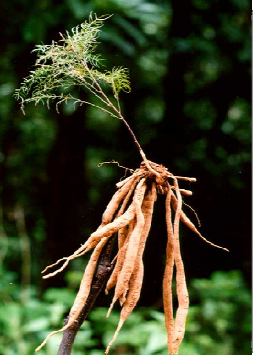
Asparagus racemosus (Shatavari)
Family: Liliaceae
Asparagus racemosus is a perennial, prickly climber that is excessively branched and produces tuberous greyish-white roots measuring 15–40 cm in length. It is cultivated for both medicinal and ornamental purposes.
Common Names:
English – Wild Asparagus
Sanskrit – Satamuli, Shatavari
Kannada – Satavari
Hindi – Shatavar
Tamil – Kilavari
Distribution:
It is an indigenous medicinal plant found throughout India in tropical and subtropical regions up to 1200 m altitude and up to 1500 m in the subtropical Himalayas.
Agro-Climatic Requirements:
The crop grows under varied agro-climatic conditions ranging from temperate to tropical hill regions. By nature, the plant is xerophytic and prefers semi-arid to cool subtropical environments.
Varieties:
No named varieties have been developed.
Cultivation:
It can be propagated through seeds as well as vegetative methods.
Seed Propagation:
Ripe fruits are collected preferably during December–April, washed thoroughly to remove pulp and sun-dried. Seeds are soaked in water for two days before sowing or treated with gibberellic acid for improved germination. Sowing is done in June–July. Seeds are sown 2 cm deep on raised beds of 4.5 m × 1.2 m × 20 cm. Lines are spaced about 10 cm apart. Germination occurs within 15–20 days with 70–80% success rate.
Vegetative Propagation:
Tillers arising from the base of mature plants are separated and planted individually.
Transplanting and Aftercare:
August is the ideal month for transplanting. Seedlings of about 5 cm height are transferred to polybags and later planted in pits (45 × 45 × 45 cm) at 1 m × 1 m spacing. Support structures are provided for twining. Weekly irrigation is required initially; later, light irrigation is provided at monthly intervals. Regular weeding and hoeing are essential for healthy growth and better yield.
Inputs (Per Hectare):
| Sl. No | Materials | Per Acre | Per Hectare |
|---|---|---|---|
| 1 | No. of plants | 11,120 | 27,800 |
| 2 | Farm Yard Manure (t) | 8 | 20 |
| 3 | Fertilizers | The crop is grown organically | |
Plant Protection:
No serious pest or disease has been noticed in this crop.
Harvesting:
The crop matures in 12–14 months after planting depending upon soil and climatic conditions. November–December is the best time for harvesting tuberous roots when the above-ground parts start turning pale yellow.
Storage:
After harvesting, tubers are washed thoroughly in running water and sun-dried for one or two days. They are then kept in warm water for one hour to soften the outer covering, facilitating peeling. Peeled tubers are shade-dried for four to five hours and must be completely dried before storage.
Yield:
Harvesting at 12 months yields about 4–5 tonnes per hectare. Harvesting after 20 months yields about 6 tonnes per hectare along with approximately 35 kg of seeds.
Cost of Cultivation:
Approximately Rs. 62,500 per hectare (subject to market variation).
Part Used:
Tuberous roots.
Medicinal Uses:
The roots are used in juice, paste, decoction and powder forms to treat haemorrhage, diarrhoea, piles, hoarseness of voice, cough, arthritis, poisoning, diseases of the female reproductive tract, erysipelas and fever. It is regarded as a rejuvenative and aphrodisiac. Traditionally recognized as a galactagogue, 10–20 grams of root powder taken with milk helps increase breast milk production.


Reviews
There are no reviews yet.