
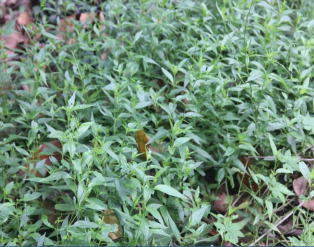
Kalmegh
Andrographis paniculata Wall. ex. Nees.
Family: Acanthaceae
Kalmegh is a bitter annual herb (perennial if maintained), erect, 50 cm to 1 m in height. Stem quadrangular and much branched. Leaves opposite and short petioled. Flowers borne in racemes. Fruit is a linear, oblong or elliptic capsule containing about 12 subquadrate, brownish or creamy-yellow seeds.
Common Names:
Kirayat, Hara-chiretta, Kalpanath
Ayurvedic: Kalmegh, Bhunimba
Unani: Kalmegh, Chirayita Desi
Hindi: Kirayat, Kalpanath
Kannada: Nelaberu, Kaala Megha
English: Creat
Trade Name: Kalmegh
Distribution:
Widely distributed throughout plains of India from Uttar Pradesh to Assam, Madhya Pradesh, Tamil Nadu and Kerala.
Part Used:
Whole plant.
Cultivation:
Soil and Climate:
Grows on a wide range of soils from loam to lateritic soils with moderate fertility. Can also be cultivated on shady wastelands. Requires hot and humid climate with ample sunshine. With onset of monsoon, plant grows vigorously and starts flowering in September with moderation of temperature. Flowering and fruiting continue up to December in northern plains.
Nursery Raising and Planting:
Propagated mainly through seeds. Vegetative propagation through layering is also possible as each node can produce roots. Seeds remain dormant for 5–6 months. For one hectare, three nursery beds of 10 × 2 m are prepared in May. Organic manure is incorporated in nursery soil. Seeds are sown and covered with a thin layer of soil and compost mixture. Beds are mulched and irrigated regularly until germination (6–7 days).
Mulch is removed immediately after germination to prevent elongation of seedlings. After 10–15 days, flood irrigation can be given until seedlings are ready for transplanting. Transplanting is done in second fortnight of June at spacing of 45–60 cm between rows and 30–45 cm between plants. Immediate irrigation is given after planting.
Thinning and Weeding:
One or two weedings/hoeings are essential during early growth. After establishment, crop suppresses weeds during monsoon.
Manures, Fertilisers and Pesticides:
Preferably grown without chemical fertilizers and pesticides. Organic manures such as Farm Yard Manure (FYM), Vermi-compost and Green manure may be applied as needed. Bio-pesticides prepared from Neem (kernel, seeds and leaves), Chitrakmool, Dhatura and Cow’s urine may be used.
Irrigation:
Monsoon rainfall is generally sufficient in northern states. Before onset of rains, 2–3 irrigations are required. Irrigation during autumn has little effect on biomass yield as plant enters reproductive phase.
Harvesting / Post-Harvesting Operation:
Maximum biomass is obtained 90–100 days after planting. If raised as annual crop in May–June, harvest by end of September at flowering initiation stage when andrographolide content is highest. Whole plant is harvested, shade dried and powdered.
Yield:
3.5–4.0 tonnes of dried herb per hectare under well-managed monsoon crop.
Economics (Year – 2001):
Expenditure per hectare: Rs. 10,000/-
Return per hectare: Rs. 43,000/-
Net income: Rs. 33,000/-
Note: Market for medicinal plants is volatile and economics may vary.
Medicinal Uses:
Whole plant is used as bitter tonic and febrifuge. It is astringent, anodyne and tonic; used in dysentery, cholera, diabetes, influenza, bronchitis, itching and piles. Leaves and roots are febrifuge. Also acts as cholagogue and anthelmintic.


Reviews
There are no reviews yet.